
AI and IoT Built for Modern Grid Operations
Electric utilities, transmission operators, distribution network providers, and renewable energy operators manage vast numbers of transformers, feeders, circuit breakers, meters, switchgear assemblies, substations, service vehicles, mobile equipment, and field personnel. Maintaining accurate visibility into these assets and workforce activities is essential for reliability, regulatory compliance, outage restoration, worker safety, and operational efficiency.
GridEnergy AI delivers AI and IoT solutions specifically designed for smart grid and energy system operations. Using RFID, BLE, GPS, LoRaWAN, cellular communications, Edge AI, machine learning, and advanced analytics, organizations can identify, locate, verify, and manage critical grid resources across substations, switching stations, distribution yards, maintenance depots, renewable energy facilities, and field service environments.
The focus is on identification and location intelligence for grid assets and workforce operations. Utility organizations gain improved visibility into transformer movements, equipment utilization, workforce dispatch, access authorization, inventory availability, and project execution status without relying on manual spreadsheets or disconnected processes.
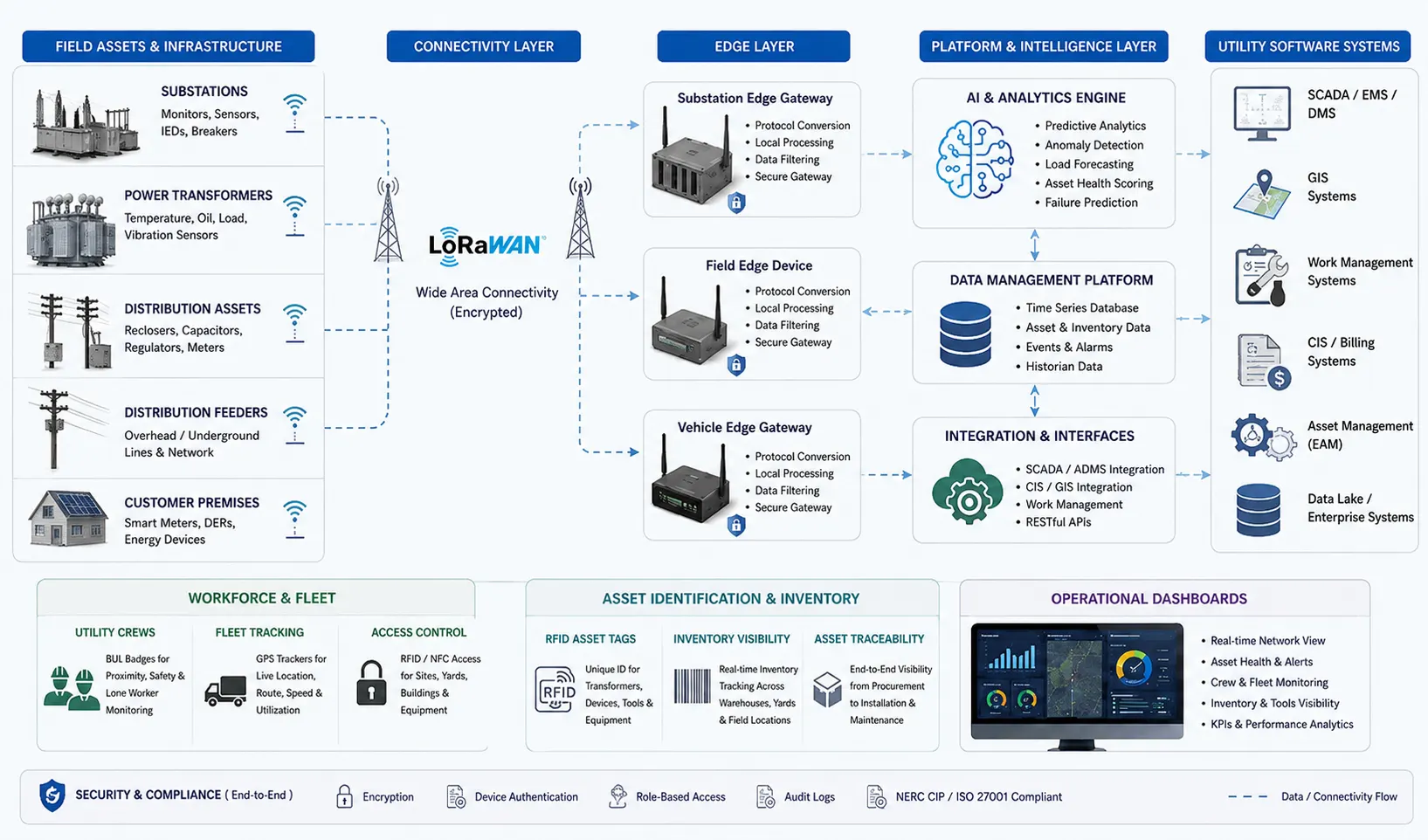
AI and IoT Smart Grid System Diagram for Utility Asset Tracking, Workforce Management, and SCADA Integration
Shows how AI and IoT technologies connect utility field assets, workforce operations, edge devices, and enterprise software into a unified smart grid ecosystem. It demonstrates data flow from transformers, substations, and distribution assets through LoRaWAN and edge computing to AI analytics, SCADA, and operational dashboards, enabling real-time asset visibility, workforce tracking, access control, and predictive utility operations.
Why Grid Visibility Matters in Modern Utility Operations
Power delivery networks depend on accurate asset identification and workforce coordination. Utility organizations frequently manage thousands of physical assets spread across large geographic territories. Key operational challenges include:
- Difficulty locating transformers, switchgear, and distribution assets during maintenance activities
- Limited visibility into field technician locations during outage restoration
- Manual verification of contractor and employee access permissions
- Inaccurate inventory records for critical spare parts
- Delays in locating equipment during emergency response
- Limited visibility into asset conditions can delay maintenance and increase operational risks
- Compliance reporting requirements across utility infrastructure
- Limited real-time visibility into grid infrastructure and operational conditions
AIoT solutions help address these challenges by connecting physical assets, workforce resources, and operational software into a unified visibility system.
Core AIoT Capabilities for Smart Grid Operations
Field Workforce Tracking
Field crews represent one of the most valuable operational resources in utility environments. GridEnergy AI enables utilities to improve workforce visibility through AI-assisted location awareness and operational analytics.
Capabilities include:
- Technician dispatch optimization
- Workforce deployment visibility
- Contractor activity verification
- Emergency response coordination
- Field resource allocation analytics
- Utility vehicle workforce correlation
- Work assignment validation
Substation Access Control
Critical utility infrastructure requires strict access governance. Substations, switching facilities, transmission assets, and control facilities must remain secure while enabling authorized personnel access.
GridEnergy AI supports:
- Automated access verification
- Digital credential management
- Workforce authorization validation
- Restricted zone access monitoring
- Contractor access auditing
- Visitor access management
- Security event analytics
- Facility access reporting
Grid Asset Tracking
Utility organizations often manage extensive inventories of transformers, capacitor banks, reclosers, feeders, switchgear, meters, and supporting infrastructure.
Grid asset tracking solutions provide:
- Transformer identification management
- Feeder equipment location visibility
- Mobile asset tracking
- Distribution equipment management
- Asset movement history
- Asset utilization reporting
- Maintenance location verification
- Lifecycle asset records
Grid Equipment Inventory Management
Inventory accuracy directly impacts outage response performance and maintenance effectiveness.
GridEnergy AI helps utilities manage:
- Spare transformer inventory
- Distribution equipment stock levels
- Warehouse inventory reconciliation
- Materials availability verification
- Maintenance parts allocation
- Utility warehouse operations
- Inventory demand forecasting
- Critical component management
Maintenance Progress Tracking
Grid modernization and maintenance programs involve complex project coordination.
Progress tracking capabilities include:
- Outage restoration visibility
- Infrastructure upgrade tracking
- Maintenance workflow management
- Crew assignment verification
- Work completion validation
- Resource utilization reporting
- Project milestone tracking
- Field activity documentation
Component Traceability
Regulatory compliance and asset lifecycle management require detailed records of equipment history.
Traceability solutions support:
- Transformer lifecycle documentation
- Component replacement records
- Meter compliance management
- Equipment deployment history
- Maintenance event tracking
- Asset ownership records
- Regulatory audit support
- Utility compliance reporting
AI and IoT Technologies Supporting Grid Operations
RFID for Utility Asset Identification
RFID technologies help utilities identify and manage physical assets across substations, warehouses, service centers, and field operations. Applications include:
BLE for Workforce and Location Awareness
Bluetooth Low Energy technology supports workforce visibility and location services in utility environments. Use cases include:
GPS and Cellular Connectivity
GPS and cellular communication technologies support utility operations across large service territories. Applications include:
LoRaWAN Connectivity
LoRaWAN supports long-range communications across utility service areas. Utility organizations can use LoRaWAN for:
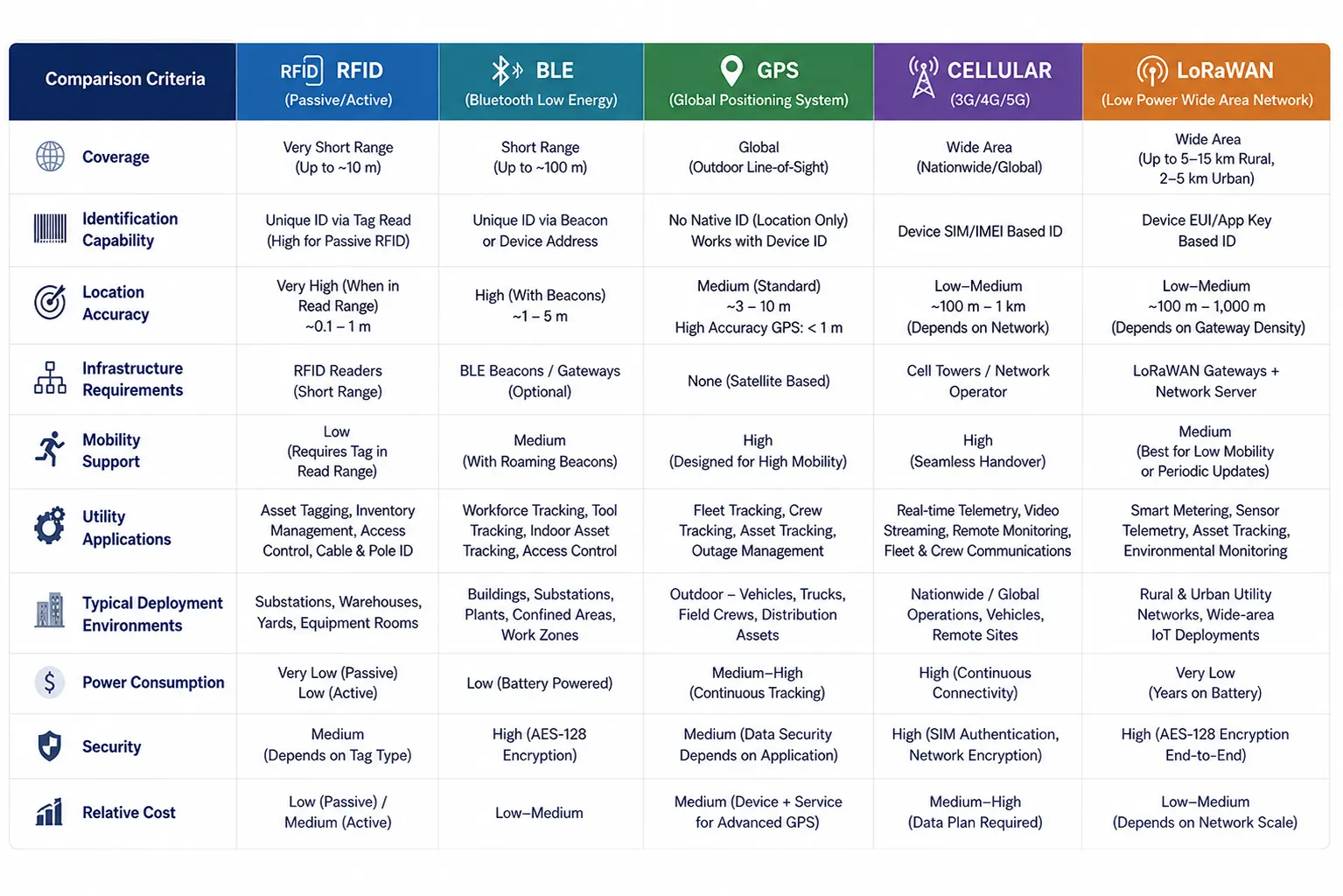
RFID vs BLE vs GPS vs Cellular vs LoRaWAN Comparison for Smart Grid Utility Asset Tracking and Workforce Management
This comparison table evaluates RFID, BLE, GPS, Cellular, and LoRaWAN technologies across key criteria including coverage, identification capability, location accuracy, infrastructure requirements, mobility support, utility applications, and deployment environments. It helps utility organizations select the most appropriate technology for asset identification, workforce tracking, inventory management, and smart grid connectivity based on operational requirements.
Utility Applications Across the Power Grid
GridEnergy AI solutions support numerous utility environments.
Transmission and Distribution Networks
Utility operators can improve visibility of:
Substation Operations
Substation teams can enhance:
Renewable Energy Facilities
Solar farms, wind farms, battery energy storage facilities, and hybrid energy projects benefit from:
Emergency Response and Outage Restoration
Utility organizations can accelerate restoration efforts through:
Flexible Deployment Options
Organizations have varying security, compliance, and operational requirements. GridEnergy AI supports multiple deployment models.
Cloud-Based Deployment
Cloud deployment supports:
- Centralized management
- Multi-site visibility
- Remote access
- Scalability
Server-Based Deployment
Server-based implementations support:
- Utility security requirements
- Internal network control
- Regulatory compliance needs
- Dedicated operational environments
Edge Processing
Edge processing enables:
- Local operational decision support
- Reduced communication dependency
- Faster processing for field operations
- Improved reliability during connectivity disruptions
Industry Experience and Technical Expertise
GridEnergy AI benefits from extensive experience developed through decades of IoT deployments across industrial sectors.
Supported by Aperture Venture Studio and GAO, the organization draws upon thousands of completed IoT projects and real-world implementation experience. Utility operators, research organizations, government agencies, Fortune 500 enterprises, and academic institutions have contributed to the practical knowledge that shapes GridEnergy AI solutions.
Technical leadership includes experienced engineers, industry specialists, and Ph.D. professionals who understand both utility operations and AIoT implementation requirements. Strong quality assurance practices, ongoing research investments, and expert support services help organizations deploy reliable solutions aligned with operational objectives.
Benefits for Utility Organizations
GridEnergy AI helps organizations achieve:
- Improved workforce visibility
- Enhanced substation security
- Better asset accountability
- Faster outage response
- Reduced equipment search time
- Improved inventory accuracy
- Stronger compliance reporting
- Increased operational efficiency
- Better workforce safety outcomes
Start Your Grid Visibility Transformation
Modern power systems require accurate visibility into people, assets, equipment, inventory, and operational activities. AI and IoT technologies provide utility organizations with practical tools to improve reliability, safety, security, and operational performance across transmission, distribution, renewable energy, and smart grid environments.
Whether the objective is transformer tracking, substation access verification, workforce visibility, inventory optimization, maintenance progress management, or component traceability, GridEnergy AI provides solutions designed specifically for utility operations and modern energy systems.
Contact GridEnergy AI
Discuss your operational requirements with our technical specialists and explore how AIoT solutions can improve grid asset visibility, workforce safety, access control, inventory management, and utility infrastructure performance.
Contact Us